
A Practical Cass County Property Search
The Cass County Elevate map is the fastest start. It works best when you know the address or map spot. It links the address to a parcel number. An owner name works better through the county tax list. So does a parcel number, city, district, or tax year. A live Cass County tax record shows the deeded owner, the property address, and two parcel-number formats. It also lists the Tax ID, legal description, township-range-section data, taxing districts, charges, and gross assessment lines.
Treat those screens as finding aids only. The Recorder's recorded instrument is the source for a conveyance. The Treasurer keeps billing and payment records. A licensed survey settles a disputed boundary, not a GIS line.
- Locate the address in Elevate or the tax list and copy the parcel number exactly.
- Compare the displayed owner with the latest conveyance in the Recorder's grantor-grantee index.
- Read assessment and tax-year details in the Assessor, Auditor, and Treasurer systems.
- Use the GIS map to understand location, adjoining parcels, and mapped geometry.
- Request an office or certified copy when the underlying document matters.
Where Cass County Keeps Property Records
Most Cass County property offices sit in the Cass County Government Building. The address is 200 Court Park in Logansport, and weekday hours generally run 8:00 a.m. to 4:00 p.m. Call ahead when you need older books, certified copies, or help with one tax year.
Two Remote Routes into Cass County Deeds
The Recorder's office runs two remote services. LAREDO suits frequent users through a subscription. Tapestry charges per search, includes image viewing, and bills extra for printing. Both accept a party name or a recording-date range. A document type, document number, or legal description also works. Searchable images reach back only to January 1, 1982. The permanent land-record collection starts in 1829.
| Search key | Best use | Local caution |
|---|---|---|
| Grantor or grantee | Find transfers involving a known person or entity | Try punctuation and entity-name variants |
| Document number | Retrieve an already cited instrument | Confirm county and recording date |
| Legal description | Follow rural acreage or a platted lot | Abbreviations can vary |
| Date and document type | Narrow a broad surname result | Images before 1982 require another route |
The Recorder page below is the official starting point. It covers service choices, fees, forms, and warnings, so open the Cass County Recorder source before choosing a remote service.
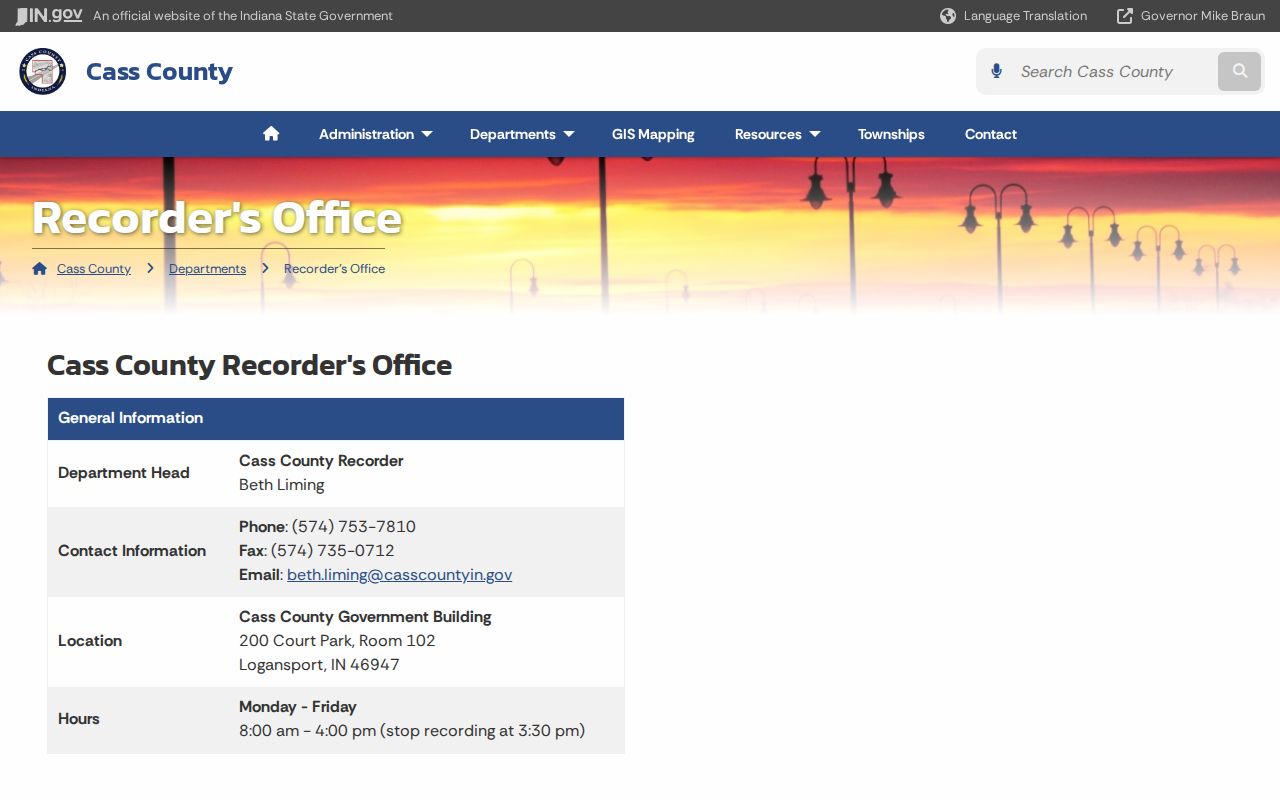
Remote images stop at 1982. The 1829 start of the collection means a complete search can still call for older books or microfilm alongside the web tools.
Cass County's 1829 Land-Record Trail
Cass County dates to 1829. The legislative act of December 18, 1828, created the county, and Recorder holdings begin with that early period. The Indiana State Library's microfilm inventory lists 48 land-record items spanning 1829 to 1904. General deed indexes cover 1830 through 1904. Deed books begin in 1829. They extend through volumes covering 1899 to 1901. Copy volume labels exactly, because the finding aid holds overlapping series and notes like "No Vol. I" in the early runs. The State Library Cass County guide adds tract books, WPA indexes, probate indexes, newspapers, and marriage material. Those records can bridge a gap the modern portal leaves.
Records That Describe Cass County Land
No single record answers every question. Match each question to its record family, then carry a parcel number, legal description, party name, or instrument reference between systems.
| Record Type | What It Documents | Kept By | Access |
|---|---|---|---|
| Deeds and conveyances | Parties, legal description, execution and recording references | Recorder | LAREDO, Tapestry, counter, copies |
| Mortgages and liens | Recorded claims and releases | Recorder | Same land-record routes |
| Assessment and tax | Deeded owner, parcel, gross assessment, charges and status | Assessor, Auditor, Treasurer | County tax/GIS systems and offices |
| Plats and parcels | Mapped shape, lot/block and recorded subdivision context | Auditor, GIS, Recorder | Elevate, plats, State Library holdings |
| Permits and zoning | Approved work and land-use decisions | Planning jurisdiction | City/county records and requests |
Start with the right record family. Use Cass County deed records for recorded transfers, property tax records for assessments and bills, and GIS parcel maps for geographic orientation.
Reading a Rural Cass County Description
Rural Cass County descriptions follow survey language. They rest on the Public Land Survey System, and the official sample tax record cites section 23, township 02N, an acreage figure, and a shortened quarter-quarter call. A legal description outlasts a mailing address. Rural routes change, but the land description holds. Before moving from the tax record to the deed index, copy every directional abbreviation, section, township, range, and acreage statement. Bring the parcel ID and Tax ID along as well.
Parcel number: an identifier linking map and tax records. Legal description: the land description carried in the recorded instrument, in lot-and-block or township-range-section terms. Plat: a recorded drawing of lots, streets, and easements. It is not a boundary survey for a present dispute.
Assessment, Deductions, and Cass Tax Bills
The Cass County Assessor sets the values. The office handles reassessment, trending, and support for the Property Tax Assessment Board of Appeals. The Auditor keeps permanent owner and transfer records, works with plats and GIS, applies qualifying deductions, and joins tax-sale duties. The Treasurer bills and collects, and explains payment options and the TS-1 statement. Indiana tax installments generally fall due May 10 and November 10, under the statutory business-day rule. A tax total is not a market price. A deeded-owner display is not the latest deed. Use one parcel number to compare years.
Note: The live county tax screen is labeled “Not for Official Use”; treat it as a lead and confirm consequential figures.
This official Assessor page covers exemptions, trending, and PTABOA.
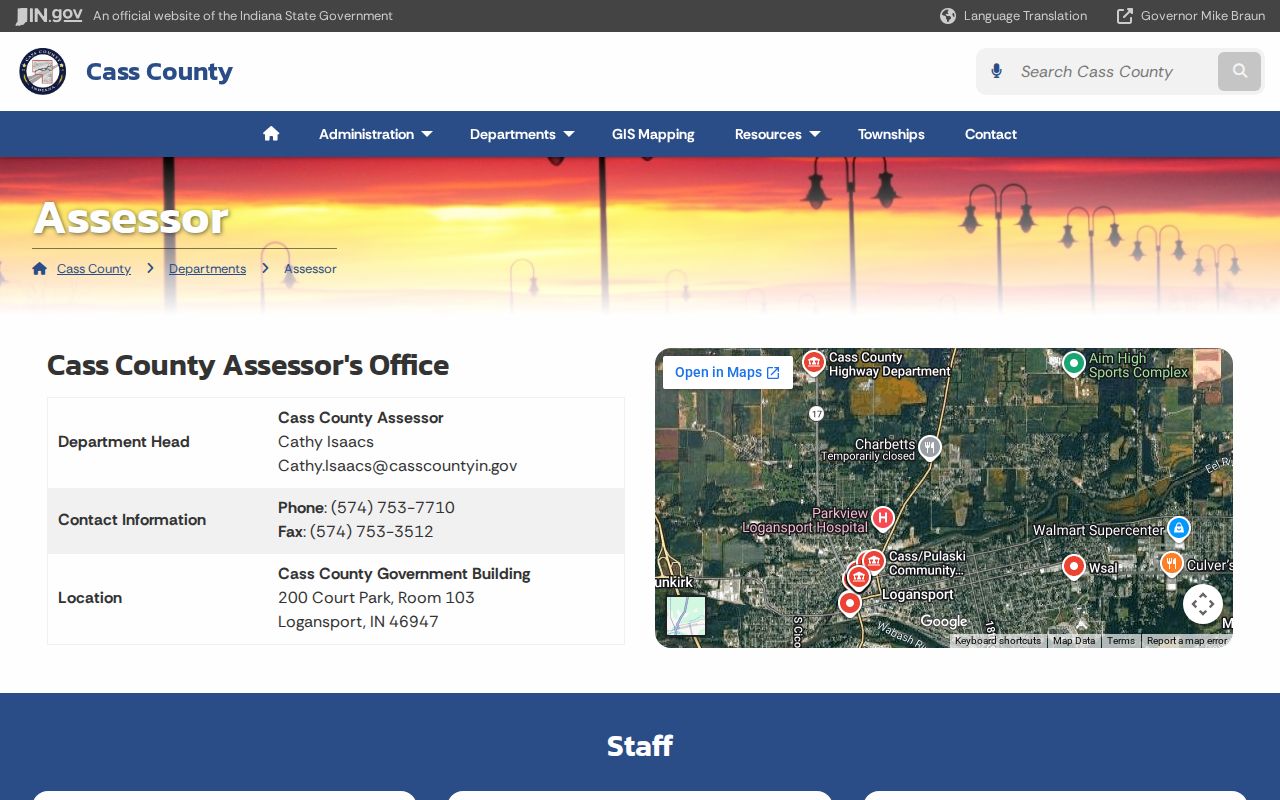
Pair office guidance with parcel-level tax and GIS results. A landing page is not the record itself.
Free Fraud Monitoring from the Cass Recorder
Cass County property owners can sign up for Property Fraud Alert. The Recorder recommends this free service. It watches for new recordings that mention a subscribed name. When a match appears, the owner gets a notice right away. That early warning makes it easier to pull the recorded instrument. Reading it early stops problems before they grow. The service is a watchdog, not a gatekeeper. It cannot block a filing or judge whether a document is valid.
Register every spelling you use on deeds, including middle initials and any business entity forms.
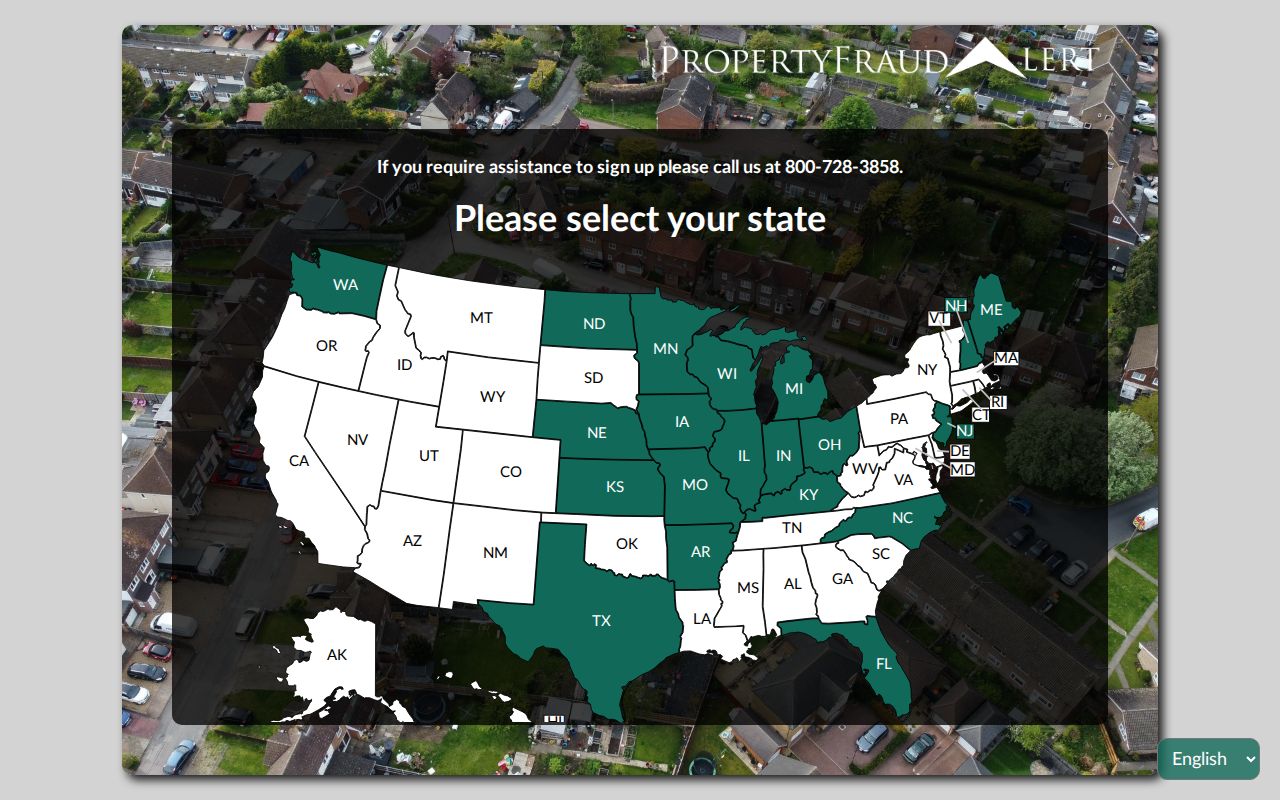
A notification is a starting point, not a verdict. Check the instrument number and image, then take concerns to the Recorder, a title insurer, or law enforcement.
Note: Cass County warns that it does not mail “Deed Processing Notice” solicitations; ordinary office copies cost $1 per page.
When the Web Search Does Not Reach the Record
The internet is not the only door into Cass County property records. Recorder staff provide copies at $1 per page. That rate covers pages 11 by 17 inches or smaller. Larger pages cost $5 each, and certification adds $5. Some older deeds still live in deed books, general indexes, or State Library microfilm. A counter visit may be unavoidable.
The Logansport-Cass County Public Library is a strong local ally for this kind of digging. Its newspapers and obituaries trace earlier owners. City directories, county histories, cemetery material, and plat books can help with an address in Cass County. When a record falls outside a normal office workflow, the Cass County Public Information Request Form can help. It can be emailed to Publicinformationofficer@casscountyin.gov or delivered to the Auditor's Office. Indiana's Access to Public Records Act demands reasonable particularity, so describe the record precisely. Inspection itself is free. Copy charges and certification limits follow Indiana law.
Cass County Plats Preserve Another Kind of History
A deed tells you who transferred what. A plat tells you how the land was carved up in the first place. In Cass County, plat and GIS work sits with the Auditor, while subdivision documents move through planning review and end in Recorder and Auditor processes. The county's subdivision checklist reflects that layered path. It calls for an owner certificate, health approval, a primary plat, covenants, roads and easements, survey and topographic information, and formal transfer steps. That paperwork makes a recorded plat an excellent companion to a deed's abbreviated lot-and-block description.
The Indiana State Library Cass map catalog lists county plat-book holdings for 2004, 2011, and 2020. Each edition is a dated snapshot. Comparing them can explain changed roads, subdivision names, and parcel configurations over time. For a current answer, weigh any old plat against the GIS and the recorded documents that govern today. View the State Library's Cass County plat-book listing to see what editions are held.
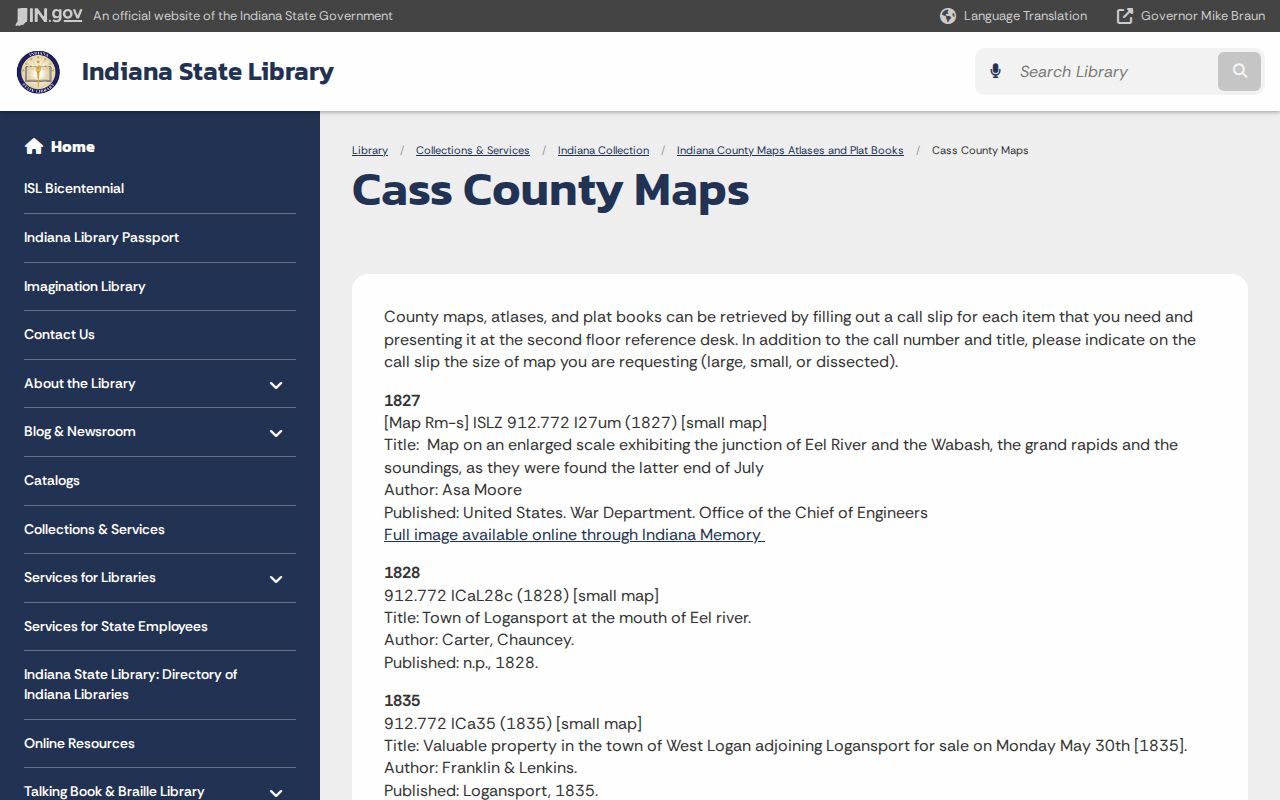
Note: Treat a historic atlas as a record of its own publication year, never as proof of a current legal parcel boundary.
Which Official Source Deserves the Most Weight?
Official systems each serve a different administrative purpose. A fresh deed reaches the Recorder long before the assessment roll refreshes. So an apparent conflict is often timing, not error. A tax bill may go to an absentee owner. GIS geometry can look rough next to the plat or metes-and-bounds description written into the deed itself.
| Question | Best first source | Confirmation |
|---|---|---|
| Who is displayed now? | Tax/assessment record | Latest recorded deed |
| What transferred? | Recorder instrument | Legal description and related instruments |
| What is billed? | Treasurer tax record | Office receipt or certified account information |
| Where is the parcel? | Elevate GIS | Recorded plat, deed, and survey |
Commercial sites can help you discover a parcel fast. But they lag official updates and blur people with similar names, so confirm any result with the named public custodian before relying on it.
Property-Related Court Records Add a Separate Layer
Recorded instruments and court cases live in different places. A mortgage, assignment, release, mechanic's lien, lis pendens, or judgment shows up in the Recorder's land index. Disputes over foreclosure, quiet title, partition, boundaries, easements, or estates belong to the courts. The Cass County Clerk keeps the Circuit Court and Superior Courts I–II files. Indiana MyCase offers public case information online. MyCase is not the official court record, though. Older or otherwise unavailable documents must be requested from the Clerk.
Match the details before trusting anything. Compare the cause number, parties, filing date, judgment or order, and legal description. A docket entry alone does not prove a lien was released. It does not prove a sale closed or title passed. Cass County's Auditor requires a title-changing court order signed by the judge. The order must be file-stamped by the Clerk and accompanied by a legal description. A marriage license or death certificate by itself has not changed title since October 1, 2014.
The split matters most in estate research. A will may name an heir. Yet the land still moves only through a deed, affidavit, or qualifying court order followed by Auditor and Recorder processing. Keep court evidence and recorded land evidence in their proper roles.
The Auditor Is Cass County's Transfer Crossroads
Every Cass County deed makes two stops. The Cass County Auditor keeps the permanent ownership record, the tax duplicate, office plat maps, and the county GIS connection. Sales disclosures and transfer documents land here first. The office also handles property-tax credits and tax-duplicate corrections. Tax sales, redemption ledgers, and surplus ledgers stay in this office as well. In practice, the Auditor bridges a recorded deed and the information that follows it. That includes the owner, parcel, deduction, and tax details.
Cass County defines a deed broadly for endorsement. A signed instrument that transfers or contracts for land counts, including land contracts and affidavits. The endorsement charge is $10 per parcel per deed, effective July 1, 2019. It applies on each deed. A non-exempt Sales Disclosure Form 46021 adds a $20 fee under a rule effective July 1, 2021. Exempt disclosures are free. These transfer charges are separate from the Recorder's filing and copy fees.
One rule trips up many searchers. Since October 1, 2014, a marriage license or death certificate alone cannot change title. The Auditor requires a deed, affidavit, or court order containing the legal description. Court orders also need the judge's signature and a Clerk file stamp. A marriage or death record may explain a name change. It is still not the transfer instrument, so the land record stays put.
The Auditor's Public Document Center is linked from the county site. Its interface offers no stable search fields. Call 574-753-7720 for a specific transfer, tax-duplicate correction, plat, deduction, or tax-sale record. Name the parcel number. Add the owner spelling, an approximate date, and the record type. Skip requests for a new ownership history.
Cass County's Public Information Request process is a fallback. It covers an existing record only. It does not replace the Recorder, Assessor, Treasurer, or Clerk portals. State the record type, parcel or instrument number, parties, and date range with reasonable particularity, so the custodian can route the request without building a new compilation.
Limits of Cass County Property Records
Cass County property records answer many questions but not all of them. They can identify an indexed owner of record. They can document a recorded transfer. They can also show assessment and tax roll data, and place a parcel on a county map. They cannot reveal an unrecorded agreement, guarantee that every lien has been found, identify a trust's beneficial owner, settle a disputed boundary, or state what a buyer will pay at closing.
Entity names deserve a second look. Check them in the Recorder's deed index and, where relevant, Indiana's business filings. Do not assume a registered agent personally owns the land.
Recorded is not guaranteed title. Use these public records for lawful property research and due diligence; obtain professional title or survey work when legal rights depend on the answer.