
Fields in Cass County Property Tax Records
The county's indexed real-property detail pulls identifying, geographic, assessment, and billing data into one record. The live list, labeled 2025 payable 2026 and marked "Not for Official Use," groups results into those categories.
| Field | What It Shows | Where |
|---|---|---|
| Deeded owner, address, parcel, Tax ID | Links the account to a party and land unit | Tax detail/Auditor data |
| Land and improvement gross assessment | Separates assessed components and cap classification | Assessor |
| Deductions and exemptions | Adjustments that affect taxable calculation | Auditor and TS-1 |
| Township, section, tax and school district | Places the parcel in assessment and taxing geography | Tax detail |
| Installment charges and payments | Amounts billed, paid, and remaining for a tax year | Treasurer |
| Legal description and GIS link | Cross-reference to recorded land and map context | Tax detail/GIS |
Indiana assessments target a statutory market-value-in-use standard. Even so, the assessed value, the taxable figure after deductions, the billed tax, and a negotiated sale price each answer a different question.
The Cass Tax List Has Six Useful Search Keys
The public tax list offers six search keys. These are property or parcel number, owner name, property address, an optional city, tax year, and district. The county warns that too much information can narrow results. Start with one strong value. Scan what comes back. Then add a city or year only if the rows demand it.
| Search field | Use | Cass-specific tip |
|---|---|---|
| Parcel/property number | Exact account match | Try the format displayed on the latest bill |
| Name | Find bills under an individual or entity | Use last name or simplify punctuation |
| Property address | Known situs lookup | Do not substitute the owner's mailing address |
| City | Narrow the place | Useful where street names repeat |
| Tax year | Retrieve a particular billing period | Distinguish assessment year from payable year |
| District | Filter taxing geography | Confirm against the result's district labels |
A parcel split or combined within the past two years may not surface cleanly. The Treasurer recommends searching by last name to catch every bill, or calling the office directly.
TS-1 Is Cass County's Compact Tax Explanation
The Tax Summary 1 is tucked into every bill. It is the Treasurer's own explanation of what changed. It carries a message to the owner and the assessed value. It also lists exemptions, ditch information, detailed tax rates, and the percentage increase or decrease in taxes. That makes TS-1 the best single answer to why a bill moved. The searchable account shows parcel-level charges and status.
Compare the same parcel across years. Isolate the shifting component: gross assessment, deductions, tax rate, district, or a special charge. A big percentage change does not prove an assessment error. It may just reflect a deduction change or different tax geography.
Gross assessment: land and improvement amounts before deductions. Deduction: a qualifying reduction applied through the Auditor. Tax rate: the combined rate for applicable taxing units, shown in the bill detail. Tax lien: the statutory claim from unpaid property tax; confirm payment status with the Treasurer.
Look Up and Verify a Cass County Tax Bill
Treat the county tax list as your discovery tool. Confirm payment and delinquency with the Treasurer, and keep a copy of your query along with its last-updated date.
- Search by parcel number or a simplified property address; use owner name when a recent split may have produced several bills.
- Confirm the tax year, payable year, deeded owner, legal description, and district before reading the balance.
- Compare gross land and improvement assessment with deductions and the TS-1 explanation.
- Contact the Treasurer about delinquency or tax-sale status rather than relying on an online payment attempt.
- Assessed value
- The Assessor's value for the statutory assessment process, not a sale offer.
- Payable year
- The year in which tax based on the assessment is billed.
- Homestead deduction
- Indiana relief tied to a qualifying principal residence and filing rules.
- Delinquency
- An unpaid obligation requiring current confirmation with the Treasurer.
Cass County's 2026 Tax Dates Are Operational Facts
The Treasurer's calendar puts the spring 2026 installment at May 11, 2026. The fall installment lands on November 10, 2026. Payments left in the drop box after 4:00 p.m. on a due date count as late. Mail goes to Cass County Treasurer, 200 Court Park, Room 104, Logansport, IN 46947.
Never reuse these dates for another year without checking the current Treasurer page. Weekends, holidays, and the statutory calendar can shift the operational date. Save a confirmation number or receipt for every payment.
Note: A variable convenience fee applies to card payments, and Cass County states that it receives none of that fee.
Online Payment Does Not Cure a Cass Tax Sale
The Treasurer's warning here is unusually direct. Paying online does not pull a property out of tax sale. Delinquent, tax-sale property demands contact with the office. Payment must be in person, in cash or certified funds. An acceptance screen from a portal proves nothing about sale status, penalties, or redemption.
The roles split between offices. The Auditor publishes tax-sale notices, handles recording, deeds, and redemption or surplus ledgers. The Treasurer confirms the account and the eligible payment route. Recorder records may later hold instruments tied to the process. A tax list, sale list, certificate, redemption, and recorded tax deed mark different stages. So check each office.
Tax-sale caution. Contact the Cass County Treasurer at 574-753-7850 before attempting to resolve a delinquent parcel listed for sale.
Cass County Deductions Have Their Own Calendar
The Cass County Auditor processes homestead and standard, over-65, blind or disabled, and disabled-veteran deductions. For the published 2026-pay-2027 cycle, filings close January 15, 2027. Homestead property must be owned and occupied by December 31, 2026. Only one Indiana homestead credit is allowed per taxpayer.
Use the Indiana DLGF deduction and credit resources for state forms and requirements. Then confirm county filing steps with the Auditor. A deduction appearing last year proves nothing now. Recheck ownership, occupancy, age or disability rules, and supporting documents for the current cycle.
Assessment Work Continues Between Bills
The Cass County Assessor values residential, agricultural, utility, exempt, industrial, commercial, cemetery, and other real estate. The office runs continual reassessment and annual trending, processes sales disclosures and exemptions, draws on mapping and building-permit data, and supports the Property Tax Assessment Board of Appeals. Review the Assessor source page before raising a value question.
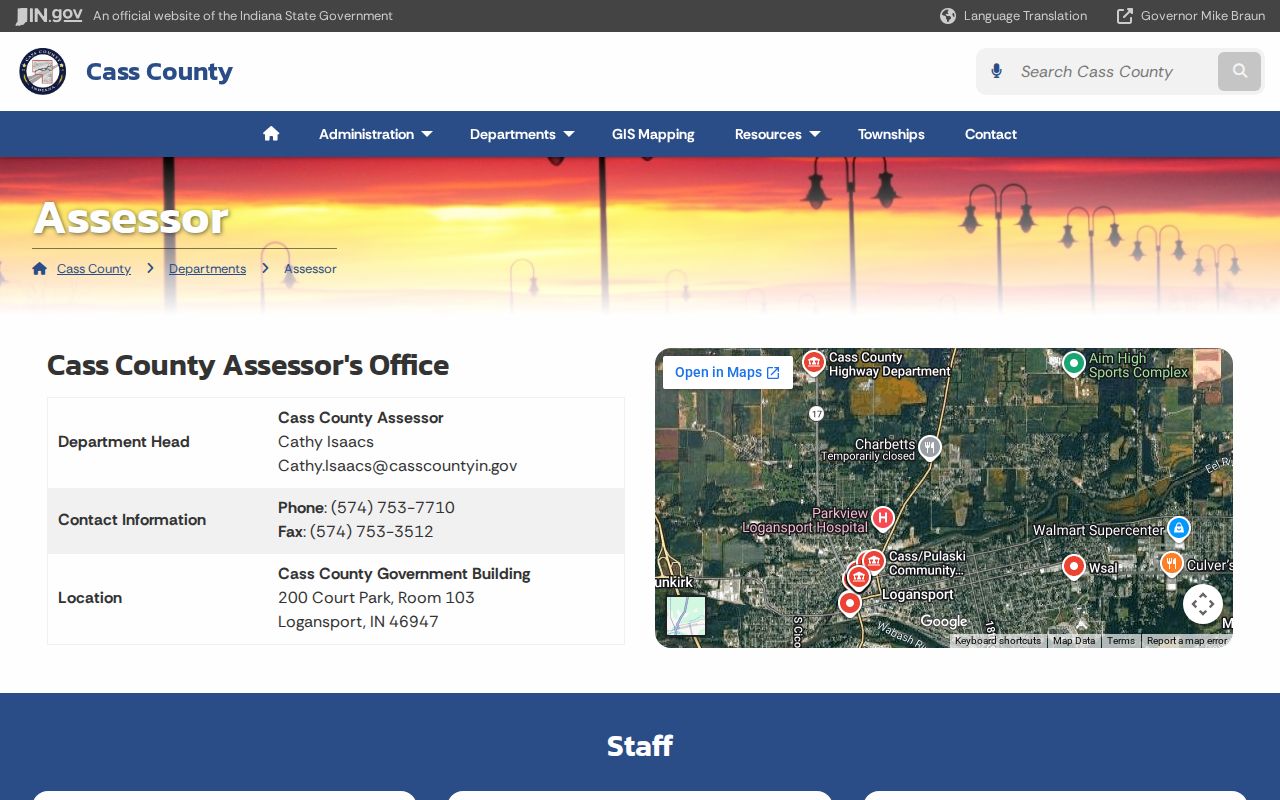
That workload explains the lag. A changed improvement, property class, trending factor, sale, or mapping correction can move an assessment record long before the change lands on a later bill.
Sales Disclosure Is a Different Value Record
Indiana's sales-disclosure search reaches disclosures filed after July 1, 2008 and lets you line a transaction up against assessment data. The Auditor takes disclosures with transfer documents. The published fee is $20 for non-exempt disclosures, with exempt filings free; a $10-per-parcel deed endorsement fee also applies under the county's transfer rules. The DLGF sales-disclosure page publishes the form details.
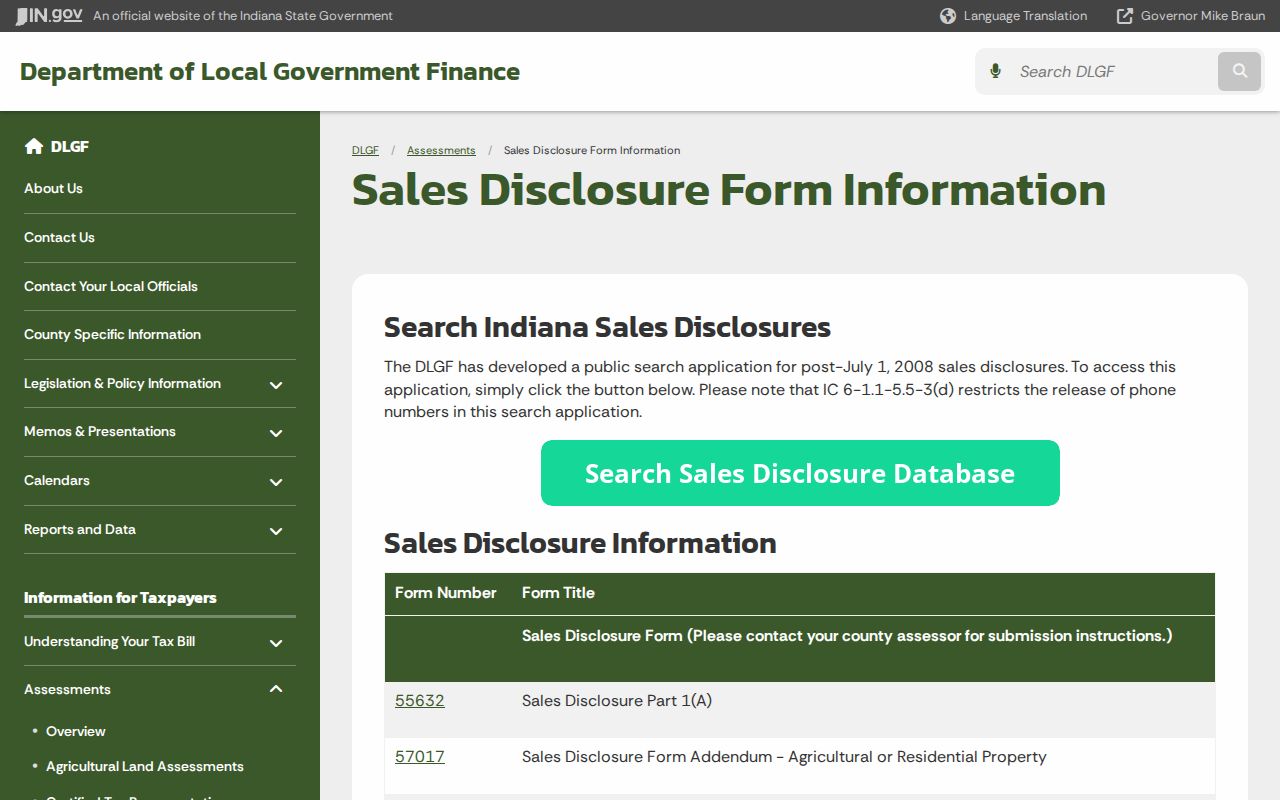
A disclosure or deed consideration can shed light on sale evidence. Neither number should mechanically replace the Assessor's dated land and improvement values.
Read Cass County Assessment Components Separately
A Cass County tax record splits the numbers into two gross figures. These are land assessment and improvement assessment. Each line also carries a property-tax cap classification. That split matters when a bill moves. Land value can shift with acreage, classification, neighborhood factors, or annual trending. Improvement value moves for different reasons. Those reasons include construction, demolition, condition, use, or corrected property characteristics. Before blaming one cause, compare the same parcel across like years.
The record also names the surrounding taxing geography. One example classified a parcel as a residential one-family dwelling on unplatted land of 0–9.99 acres. It showed one acre with distinct land and improvement figures. Fields included Jefferson Township, a tax-district code, Pioneer Regional School Corporation, and a township-range-section legal description. The fields give the parcel its full taxing context. This is why two nearby properties can carry different tax bills. Even similar apparent market values do not guarantee matching bills. Classification, improvements, deductions, cap treatment, and taxing geography may all differ.
| Comparison item | Keep constant | Question to ask |
|---|---|---|
| Land assessment | Assessment year and acreage | Did land classification or parcel area change? |
| Improvement assessment | Structure and condition date | Was a permit, reassessment, or correction reflected? |
| Deductions | Eligibility and filing cycle | Was a homestead or other deduction added or removed? |
| Tax rate and district | Same payable year | Did taxing geography or the combined rate change? |
| Sale disclosure | Actual sale date and terms | Is the transaction comparable to the subject? |
Use three documents together for a defensible comparison: the Assessor's parcel record, the TS-1, and sales-disclosure evidence. The deed proves the conveyance happened; it does not automatically convert its consideration into the assessed figure.
Tax Corrections Move Through the Cass Auditor
The Cass County Auditor wears several hats. The office processes corrections to the tax duplicate. It also handles owner transfers, credits, deductions, plats, and GIS responsibilities. When a parcel, owner, legal description, deduction, or duplicate looks wrong, name the specific field and tax year. Then call 574-753-7720. Bring the deed, assessment notice, prior bill, or survey or plat citation. Any other source showing the mismatch helps too.
A corrected administrative field is not the same as a successful valuation appeal. The Auditor routes duplicate and deduction issues. The Assessor and PTABOA handle assessment disputes. The Treasurer posts payments and tracks delinquency. Sending the problem to the right Cass office cuts the risk of a missed deadline. It also avoids asking one custodian to change a record it does not control.
Contest a Cass County Assessment Carefully
The Assessor handles assessment appeals. The Property Tax Assessment Board of Appeals serves as the county route for disputed valuations. The county page publishes no stable parcel-specific deadline, complete form inventory, or hearing calendar. So call the Assessor at 574-753-7710 soon after the notice arrives. Confirm the current form, delivery method, and deadline.
Build the evidence around the assessment issue itself. Useful materials include property record card errors, dated photographs, measurements, use and condition, and comparable sales with meaningful adjustments. Relevant appraisals also help. So does proof that the wrong parcel, classification, or improvement was used. Preserve the notice and proof of timely filing. A disagreement with the tax bill alone may not pinpoint the valuation error.
Appeal window. Cass County's current deadline was not stable in the researched materials; verify it directly with the Assessor/PTABOA rather than assuming a general date.