
Compare Cass County Property Value Types
Cass County records split value into pieces that everyday speech squashes together. Indiana assesses real property at a 100 percent level of true tax value. Even so, the figure is a mass-appraisal result tied to a stated assessment date and tax cycle, not a one-by-one opinion of your parcel.
| Value | What It Is | Where |
|---|---|---|
| Gross assessed value | Land plus taxable improvements before deductions | Assessor and tax detail |
| Taxable value | Assessment after applicable deductions | Tax bill context |
| Recorded sale evidence | Consideration or disclosure tied to a transfer | Recorder and DLGF |
| Land and improvement | Separate allocation to site and structures | Assessment detail |
Sale price reflects a single transaction and its conditions. An assessment applies a countywide valuation process instead. Deductions shift the taxable burden without altering the parcel itself, or sometimes even the gross assessed value. Label the exact field you are reading. Calling every number “market value” invites error.
Locate a Cass County Assessed Value
Search the Cass Treasurer or Auditor property list with an exact address, parcel number, owner name, tax year, or district. Open the parcel detail page. Confirm the legal description and identifiers match before you record any values.
- Find the exact parcel in the tax or GIS system.
- Record land, improvements, gross assessment, deductions, and tax year.
- Check the latest recorded deed and sales disclosure for dated sale evidence.
- Compare prior years only after checking parcel splits and building changes.
- Assessed value
- The official mass-appraisal figure assigned for property-tax administration.
- True tax value
- Indiana's market-based valuation standard for assessment.
- Level of assessment
- The relationship between assessed value and the valuation standard.
Read Cass Land and Improvements Apart
A Cass tax detail separates land and improvement assessment lines from the gross assessment. That split often explains why a total moved. New construction can lift improvement value while land holds steady. Demolition can produce the opposite pattern.
Preserve each figure exactly as displayed, together with its tax year. An allocation between land and improvements is not the price a buyer would assign to either piece. Note that the online tax detail carries a “Not for Official Use” label. For a formal dispute, obtain an official record.
Cass Reassessment Runs on Two Clocks
Two clocks drive Cass reassessment. Annual trending adjusts values with market evidence between broader reviews. Indiana’s current cyclical reassessment frame runs from 2026 through 2030. Roughly 25 percent of parcels are inspected each year. So a changed value may come from trending. It may also come from an inspection, corrected property characteristics, or new construction.
Compare the property record’s assessment date, tax year, and physical-characteristic history. Does the record alone fail to explain the change? Ask the Cass County Assessor which factor moved.
Deductions Change Cass Taxable Value
Homestead, over-65, blind or disabled, and disabled-veteran programs sit apart from ownership and gross valuation. A deduction can lower taxable value or tax burden. The parcel and deed stay untouched. Compare deduction status along with the assessment itself.
The Auditor administers deductions and permanent owner records. The Assessor handles valuation. A missing or changed deduction is not proof the county reappraised the land. Record the deduction name and year beside the value fields. Then a later comparison never mistakes a tax-benefit change for appreciation.
Sales Disclosures Add Dated Evidence
Indiana’s searchable sales-disclosure evidence begins July 1, 2008. It works well for comparing a reported transfer against assessment history, though exclusions and reporting limits keep it from being a universal sales database.
Match each disclosure to the parcel and the Recorder instrument. Note the sale date, deed type, consideration, related parties, and any parcel split. A quitclaim or family transfer may not serve as a market benchmark.
Tax Bills Are Not Value Opinions
The Cass Treasurer’s TS-1 explanation separates assessed value, deductions, tax rates, ditches, and percentage change. Tax due reflects far more than valuation. Rates and deductions can move the bill even when gross assessment holds level.
For the 2026 cycle, the Treasurer page lists spring due May 11. Fall due is November 10. Those dates belong to billing administration. They do not fix the date on which a private buyer would value the property.
See the Cass Assessment Source
The Cass County Assessor page explains assessment duties, reassessment, trending, and PTABOA review.
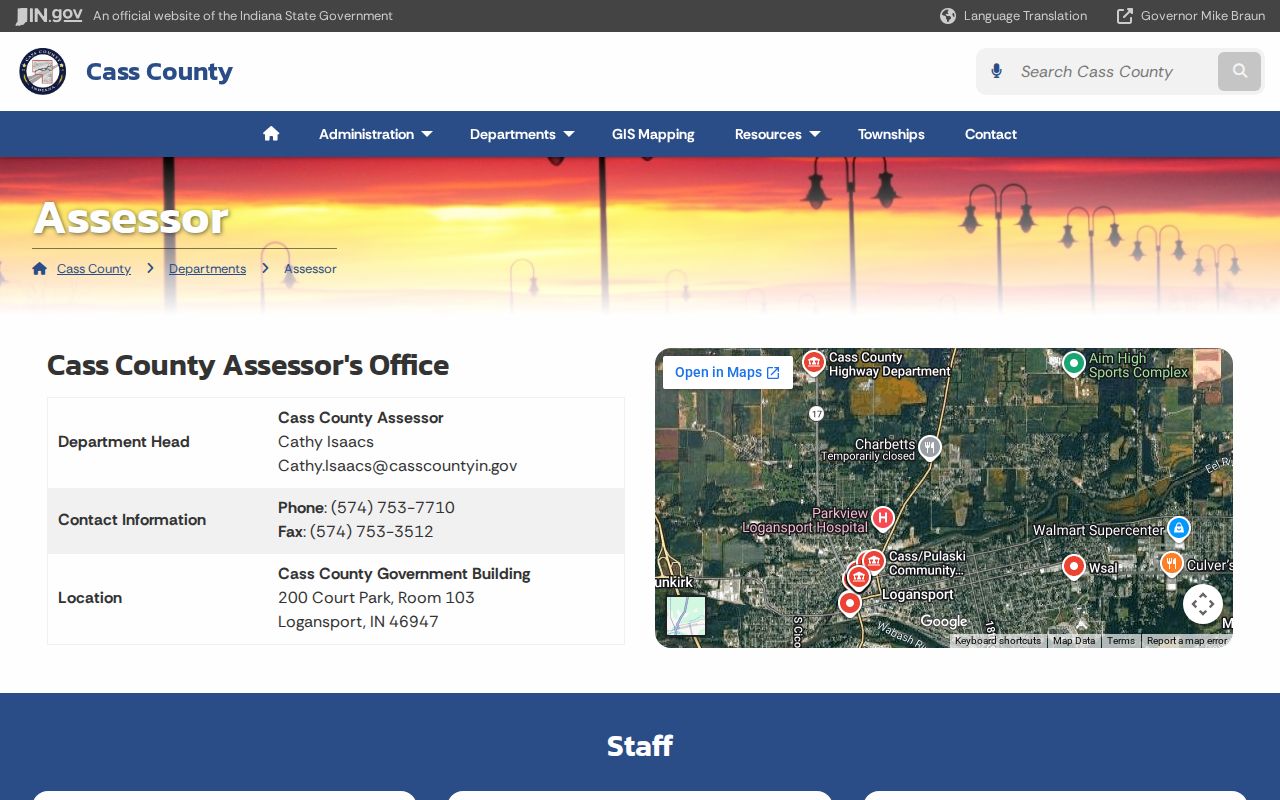
Use the office’s contact route to request the underlying property record or ask why a dated figure changed. Carry the parcel number and tax year into every question.
Appeal a Cass County Assessment
A taxpayer who disputes an assessment follows the county Assessor and Property Tax Assessment Board of Appeals process. The evidence should speak to the assessed value. It should also address the correct valuation date, not merely a preferred sale price.
Preserve notices, property characteristics, photos, comparable sales, disclosures, and prior records. Confirm the current filing window and form with the Assessor. Deadlines control whether PTABOA can hear the appeal.
Deadline check. Verify the appeal deadline shown on the current notice before preparing a value comparison.
Compare Cass Values Across Years
Indiana reassesses property on a cycle, and trending fills the gaps. Trending adjusts assessed values with market evidence between the big reviews. It is not a fresh appraisal of every parcel. The current statewide cycle runs from 2026 through 2030. Roughly 25% of parcels get reviewed each year. That schedule helps explain why a Cass County property value shifts. The parcel record and the notice still tell you what actually happened to your property.
Keep the property identity fixed when comparing two years. Pull the same parcel number and Tax ID for both years. Compare the same land and improvement categories. Watch for splits, combinations, new construction, demolition, classification changes, or deductions. A percentage jump on the TS-1 can mix assessment effects with tax-rate effects. Do not report it as market appreciation without more evidence.
Note: Cass County publishes no official city-specific value trend for Logansport, Galveston, or Walton. Do not invent one from countywide figures.
Test a Cass Value Breakdown
A Cass County tax detail shows how an assessment gets assembled. The sample here is a residential one-family dwelling on unplatted land, one acre recorded, in the 0 to 9.99 acre class. Its gross assessment lines show $21,000 for land and $45,500 for improvements. Each component covers the stated tax year. Neither figure is a asking price or a guaranteed sale value.
The same record carries the township, section, tax district, school district, legal description, parcel number, Tax ID, and current charges. Those fields confirm you are comparing the correct property. Match land against land. Match improvements against improvements. A nearby parcel with different acreage, use, district, exemption status, or structure mix is not a sound comparable just because it sits close on the map.
Sale Evidence Is Not an Appraisal
Indiana's sales-disclosure information covers qualifying transfers from July 1, 2008 forward. It comes with exclusions and reporting limits. A disclosed consideration is one transaction fact. It is not a universal sales database. It is also not a present appraisal. Tie the sale to the Cass parcel, deed date, legal description, and property condition. Only then use it to interpret assessed value.
The Recorder's deed shows who conveyed an interest and when the instrument was recorded. The Assessor weighs market evidence inside Indiana's assessment system. A private appraisal analyzes the subject property for a stated effective date and purpose. Keeping those roles straight stops a last sale price from standing in for assessed value. It also stops a county assessment from being passed off as today's negotiated market price.
Cass Deduction Dates and Custody
A deduction can change a tax bill without touching the land, the improvements, or the owner name. Homestead, over-65, blind or disabled, and disabled-veteran deductions all work this way. Cass sets the filing deadline for the 2026-pay-2027 cycle at January 15, 2027. The homestead ownership-and-occupancy condition looks back to December 31, 2026. Confirm later-year dates with the Auditor.
Keep gross assessment, deductions, and the final bill separate in any value comparison. The Treasurer collects taxes and explains TS-1 fields. The Auditor processes credits and deductions. The Assessor determines assessed value and handles appeals through PTABOA. Route each question to the right office. A lower bill will not then be mistaken for proof that the county cut the underlying property value.
Limits of Cass County Property Value
The Assessor's value is a mass-appraisal figure built for tax purposes. It is not a guaranteed sale price. It is not a title opinion, a survey, or a parcel-specific private appraisal. Markets can move between valuation dates. Unusual property conditions may never surface in a public summary.
Hire a licensed appraiser when you need a current opinion. Rely on recorded instruments for ownership and on parcel maps for orientation only. Each source deserves to stay within its purpose.
Value vs price. A Cass County assessed value is not a prediction of what the property will sell for. Obtain a qualified appraisal for a current market opinion.