
Deed Types in Cass County Records
The Recorder indexes more than 130 document types. "Deed" is just the doorway into Cass County property records. What matters is the instrument's actual wording and its legal description, not a shorthand label.
| Deed Type | What It Does | Common Use |
|---|---|---|
| Warranty deed | Conveys the stated interest with deed warranties | Arm's-length or other conveyance |
| Quitclaim deed | Conveys whatever interest the grantor has without those warranties | Family, estate, or title-cleanup transaction |
| Personal representative or trustee deed | Conveys through a fiduciary capacity | Estate or trust administration |
| Sheriff or tax deed | Records a transfer arising from a statutory sale process | Foreclosure or delinquent-tax matter |
| Plat | Records a subdivision or mapped land division | Linking lot-and-block descriptions |
A lien is not a deed. Mortgages record a claim against the land rather than transferring it, and later filings decide whether that claim still binds the parcel. Pull the release. Pull the assignment too.
LAREDO and Tapestry Serve Different Searchers
The Cass County Recorder runs two Fidlar search portals. LAREDO demands a subscription and suits sustained work, offering 24-hour access to searchable images from January 1, 1982 forward. Tapestry is pay-per-search, images included, with printing billed separately.
| Index field | Purpose | Technique |
|---|---|---|
| Party name | Find grantors, grantees, lenders, and entities | Try initials, punctuation, trust, and LLC variants |
| Recording date range | Limit the period | Search beyond the expected closing date |
| Document type | Separate deeds, mortgages, releases, and plats | Run a broader search if the type was indexed unexpectedly |
| Document number | Retrieve a known instrument | Verify date and county |
| Legal description | Match a tract or platted lot | Reuse abbreviations from the prior deed |
Open the Tapestry search entry shown in the approved capture below.
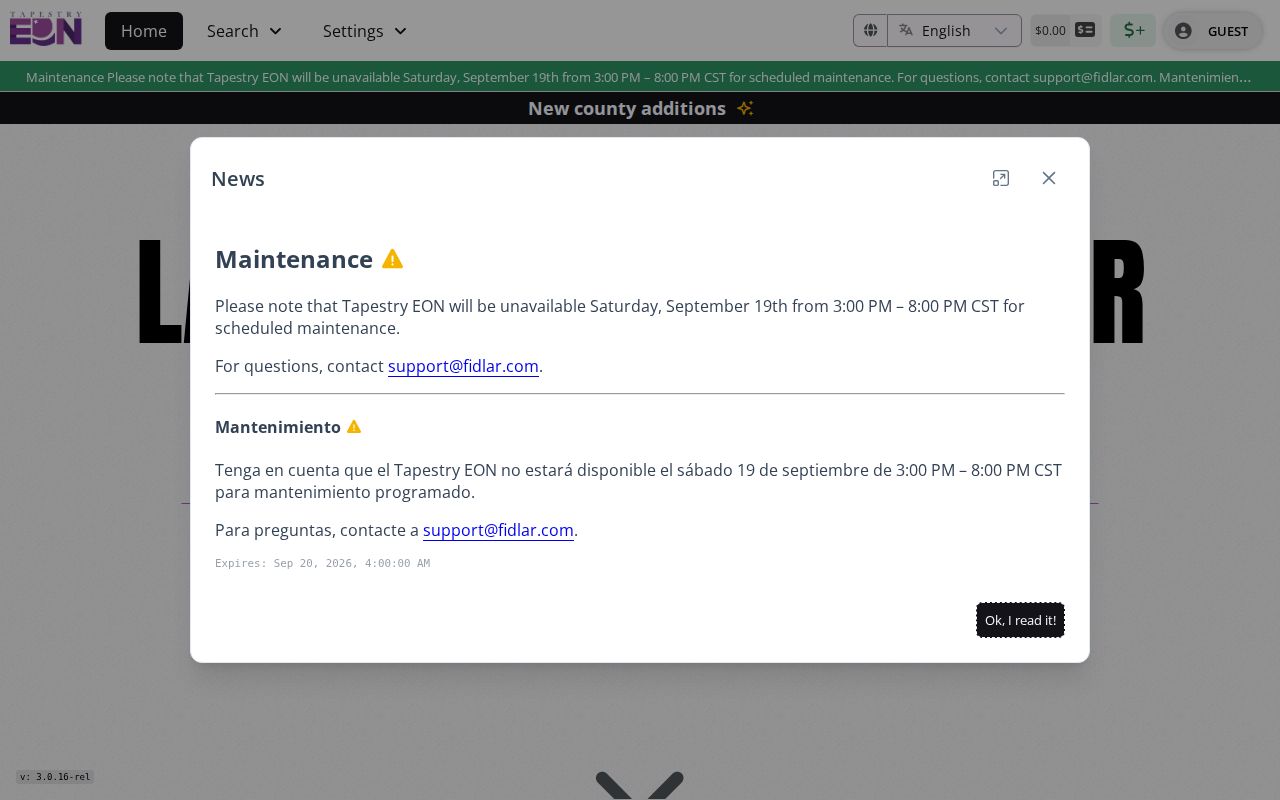
A login screen is not a deed result. Retain the document number, obtain the image or an office copy from the Recorder, and only then draw conclusions about what was filed.
Follow the Cass County Grantor-Grantee Index
The grantor conveys; the grantee receives. To walk a chain backward through Cass County property records, start with the current owner of record's acquisition deed. Read its grantor. Then hunt that party's own earlier deed as a grantee, using legal descriptions and instrument references to keep every link tied to the same parcel.
- Use the current deeded-owner spelling or a known instrument citation to find the acquisition deed.
- Record the grantor, grantee, date, document type, document number or book/page, and full legal description.
- Search the grantor as an earlier grantee and compare the land description before accepting the match.
- Repeat through remote images, then shift to general indexes, deed books, or microfilm before 1982.
- Grantor
- The party named as transferring the interest.
- Grantee
- The party named as receiving it.
- Chain of title
- The linked sequence of recorded transfers for the same land.
- Book/page and instrument number
- Two citation systems that direct staff or a portal to a recorded document.
Cass County Deeds Begin in 1829, Not 1982
Cass County's land records run from 1829 to the present, according to the Recorder. The 1982 date belongs to LAREDO alone. The Indiana State Library microfilm inventory lists 48 land items dated 1829–1904. General deed indexes cover 1830–1904. Deed books start in 1829. That older material survives on microfilm.
When requesting early volumes, copy the finding aid's label exactly, since some series overlap or carry notes such as "No Vol. I." The Cass research guide also identifies tract books and probate indexes that can recover a missing name or date when the direct deed chain stalls.
| Period | Likely route | What to preserve |
|---|---|---|
| 1982–present | LAREDO or Tapestry, then office copy | Document number, recording date, image |
| 1830–1904 index run | General deed index and microfilm | Grantor/grantee, book and page |
| 1829-era deed books | Recorder or State Library finding aid | Exact volume notation and land description |
Probate Can Explain a Broken Deed Chain
Ownership does not always pass by sale deed. A death can interrupt the chain. Estate proceedings, trusts, court orders, partitions, quiet-title cases, sheriff sales, and tax sales all bridge gaps between names in Cass County deed records. The Cass County Clerk holds Circuit and Superior Court files, including wills, probate matters, judgments, and partition cases. Indiana MyCase offers public case searching. The Clerk keeps the files.
Treat the case number, the decedent's name, and the date as leads. Then return to the Recorder. A probate order and a deed are not the same instrument, so read what was actually recorded against the land.
Cass Plats and Legal Descriptions Keep the Chain on Track
Names repeat in Cass County. The land itself supplies the continuity. Inside cities and subdivisions, compare the addition name, lot, block, plat cabinet, and recorded plat references. Rural descriptions turn on section, township, range, quarter-section calls, acreage, and parcel identifiers. The State Library holds Cass plat books from 2004, 2011, and 2020, while the Auditor maintains permanent owner-transfer records and plat/GIS duties.
A deed may convey only part of a tract. A shared surname or a nearby parcel proves nothing. Verify the exact land conveyed and note any exceptions, easements, reservations, or incorporated exhibits before trusting the chain.
Note: Cass GIS helps orient a description, but mapped parcel lines do not replace the deed, recorded plat, or a boundary survey.
Property Fraud Alert Watches New Name Matches
Property Fraud Alert is free. The Recorder directs the public to this monitoring service, which sends a notice whenever a registered name appears in a new recording. It blocks nothing. It simply prompts you to inspect an unexpected document early.
Register every spelling and middle-initial variant. For entity-held parcels, monitor the indexed entity form. If an alert looks unfamiliar, capture the document number and recording date, obtain the image, and contact the Recorder, a title insurer, or law enforcement as the facts demand.
The Cass Recorder's Copy Fees and Access Channels
You do not need a screen to get copies. Plain copies from the Recorder cost $1 per page for paper 11 by 17 inches or smaller, and $5 per page for larger sheets. Certification adds $5. Tapestry shows images but bills printing separately, and LAREDO requires a subscription. The office sits at 200 Court Park, Room 102, Logansport, and lists 574-753-7810.
Beware "Deed Processing Notice" mailers. Cass County does not mail them. The Recorder's own warning is blunt, so order by instrument number or book and page, state whether you want a plain or certified form, and confirm delivery arrangements before sending payment.
Related Cass Instruments Complete the Deed Story
A Cass County deed rarely tells the whole story alone. The Recorder's office indexes far more than deeds. Mortgages, liens, plats, surveys, releases, assignments, restrictions, UCC fixture filings, tax liens, and powers of attorney all live in the same body of Cass County property records. Once a conveyance turns up, chase the surrounding paper. Search the same parties, the recording period, document number references, and the legal description for anything that qualifies the deed. A corrective deed may repair a misspelled name or a flawed description. A mortgage assignment swaps the indexed secured party, and a release often cites the original mortgage rather than repeating the full property description.
Some instruments shape use, not ownership. Restrictions and covenants can limit use without touching title. A plat supplies the addition, lot, block, street, and easement context a deed merely abbreviates. A power of attorney can explain a signature. It never makes the signer the owner. A UCC fixture filing concerns collateral tied to real property but is not a deed itself, so preserve each document type instead of flattening search results into a generic ownership record.
| Related filing | Question it helps answer | What to match |
|---|---|---|
| Mortgage, assignment, release | What recorded financing trail accompanies the parcel? | Borrower, lender, original instrument, legal description |
| Corrective deed | Was an earlier conveyance corrected? | Prior instrument number and correction language |
| Plat or survey | How was the tract described or divided? | Addition, lot, block, acreage, recording citation |
| Restriction or covenant | What recorded land-use terms appear? | Subdivision and incorporated references |
| Tax lien or mechanic's lien | What claim was placed of record? | Debtor, claimant, amount/date, release or satisfaction |
A broad name search can return unrelated parcels. Always confirm the legal description on each candidate deed. Rural Cass conveyances lean on section, township, range, quarter-section, and acreage terms, while city and subdivision deeds usually cite a recorded addition with lot and block references.
The Auditor Endorsement Follows a Cass Conveyance
Recording a deed is only half the journey for a new Cass County owner. The Recorder preserves the land instrument. The Cass County Auditor keeps the owner record. The Auditor also processes transfers. Its rule treats a signed legal transfer, including land contracts and certain affidavits, as an instrument that may require real-property endorsement. The endorsement fee is $10 per parcel per deed under the rule effective July 1, 2019. A non-exempt sales disclosure adds a separate $20 fee under the change effective July 1, 2021.
This administrative lag explains a common puzzle. A buyer recorded last week may not show up yet in the tax system. Compare the Recorder date, the Auditor transfer information, and the tax record's verified Deeded Owner field. The newest deed wins as evidence of a recent conveyance. The roll simply reflects the slower assessment and billing workflow. That workflow sits behind Cass County property tax records.
Obtain a Cass County Deed You Can Rely On
Save the index citation first. View the image remotely if offered. Or give Recorder staff the citation for an office copy. Certification matters when an authenticated county copy is required. Pre-1982 material takes a general-index reference plus the exact deed-book volume and page, so with no citation in hand, narrow the grantor, grantee, date span, and legal description before requesting help.
Read the whole instrument. That means the acknowledgment, exhibits, reservations, and recording stamps, not just the granting clause. Confirm the legal description, not merely the street address, matches the intended parcel, since related releases, corrective deeds, plats, and court filings may be needed to fully understand the Cass County deed records.
Recorded, not guaranteed. Cass County deed records show instruments accepted for recording; they do not establish a title opinion or rule out unrecorded interests.