
Identify Who Owns a Cass County Property
The cleanest route crosses county systems in a set order. A tax result is a trailhead. It is not the final word on title. Copy both identifiers from the result, the punctuated parcel number and the shorter Tax ID, because the Recorder, Auditor, Treasurer, and GIS may key on different numbers.
- Search the Cass Treasurer/Auditor property list by property address. If the query is too narrow, remove extra fields or try the owner's last name.
- Open the parcel detail and record the Deeded Owner, situs address, legal description, parcel number, Tax ID, and dated owner-history entry.
- Take that owner name and legal description to the Cass County Recorder. Confirm the newest deed through LAREDO, Tapestry, or an office search.
- If an LLC appears as grantee, inspect its identity and registered agent through INBiz, while remembering that the entity-not its agent-may hold title.
A sample Cass record shows why copying every field matters. Its situs address can read 6378 W US 24. The owner mailing address on the same record may show 7958 W 100 N, and neither difference signals an error or reveals who occupies the land.
Read Cass County's Deeded Owner Trail Carefully
The county property detail labels a "Deeded Owner" history and dates each entry. Individuals appear there. So do lenders and entities. One such history mixes 3H LLC, FNMA, and Holcomb names at different points. Treat the most recent dated entry as a search term, then match it to the newest recorded instrument instead of flattening everything into one conclusion.
An owner of record appears in the operative public record. A grantee receives an interest in a deed. Situs marks the property's physical address, while a mailing address receives the tax correspondence, so neither one alone proves occupancy.
Note: The county tax display carries a "Not for Official Use" notice, so formal reliance should move to the custodian's own record.
Recent Cass County Transfers Can Appear Out of Sequence
A closing, a recording, an Auditor transfer, and a tax-roll update are separate events. Timing gaps follow. After a fresh sale, the newest deed may name the grantee. The tax page may not refresh right away. Foreclosures, tax sales, deaths, affidavits, and court-ordered transfers create the same lag. Judge the instrument by its recording date and legal description. The tax year alone proves nothing about the current owner. When a court order drives a title change, the Cass Auditor says the paperwork may need a deed, an affidavit, or a file-stamped order. A judge must sign that order. A marriage or death certificate by itself changes nothing.
Entity and Estate Names Need a Second Search
An entity name is a valid ownership clue. Don't swap in a person's name. Search the exact wording of the LLC, trust, or estate, suffixes included, in the deed index. INBiz can clarify an Indiana business's status and registered agent. It cannot replace the recorded Cass County conveyance. When an owner has died or a deed cites an estate, search Indiana MyCase and the Clerk's probate index. That file may surface an order, a personal representative, an affidavit, or an estate cause explaining the transfer path. The Recorder still supplies the land instrument.
Where Cass County Property Ownership Appears
No single screen answers every version of this question. Each source for Cass County ownership carries its own custodian and its own evidentiary weight.
| Cass source | Ownership clue | Best use |
|---|---|---|
| Treasurer/Auditor detail | Deeded Owner history, mailing and situs addresses, parcel keys | Start from an address and identify the likely current name |
| Recorder deed index | Grantor, grantee, instrument, date and legal-description trail | Confirm the latest recorded conveyance |
| INBiz | Business identity, status and registered agent | Interpret an LLC name without confusing its agent with owner |
| Elevate GIS | Selected parcel polygon and APN context | Match the address to the correct parcel before checking ownership |
Use the Cass County current owner guide for present-owner detail. The past property owners workflow walks backward through earlier transfers. Deed terminology and copies live in the deed records guide.
When the Address Search Finds Nothing
Cass County's tax search accepts a last name, property address, parcel number, or city. Too much input can suppress a result. That risk rises after splits or combinations. Drop a field and retry. Try the prior owner's surname, a parcel number stripped of punctuation, or a blank city field. Postal city labels never settle incorporated boundaries. For rural land, carry the township, range, section, acreage, and legal description into the next search, since those terms stay stable when a road name or situs format shifts. The Cass parcel map guide explains Elevate as an orientation layer.
Cass Recorder Access Beyond the Web
Remote access is only one channel. Cass advertises LAREDO images from January 1, 1982 forward and Tapestry as a pay-per-search service. For older records, unusual legal descriptions, or a portal failure, ask the Recorder for an office index search and deed-book or microfilm access. The Indiana State Library's Cass County research guide supports the historic fallback.
The Recorder reports county records reaching to 1829. That depth is useful for house history, but it also means a modern owner lookup and a complete title chain are different projects.
Owner Alerts Monitor Names, Not Title
Cass County points residents to Property Fraud Alert. The service notifies a subscriber when a matching name shows up in newly recorded documents. It stops nothing. Nor does it guarantee title or prove the alert concerns the right parcel. The county also flags "Deed Processing Notice" mail. Ordinary deed copies come from the Recorder. Treat an unexpected solicitation as a cue to verify the instrument directly with the office.
The Cass Assessor Helps Tie a Name to the Parcel
The Cass County Assessor's official page identifies the office behind real-estate assessment, sales disclosures, exemptions, appeals, and annual trending. It also maintains mapping used for reassessment.
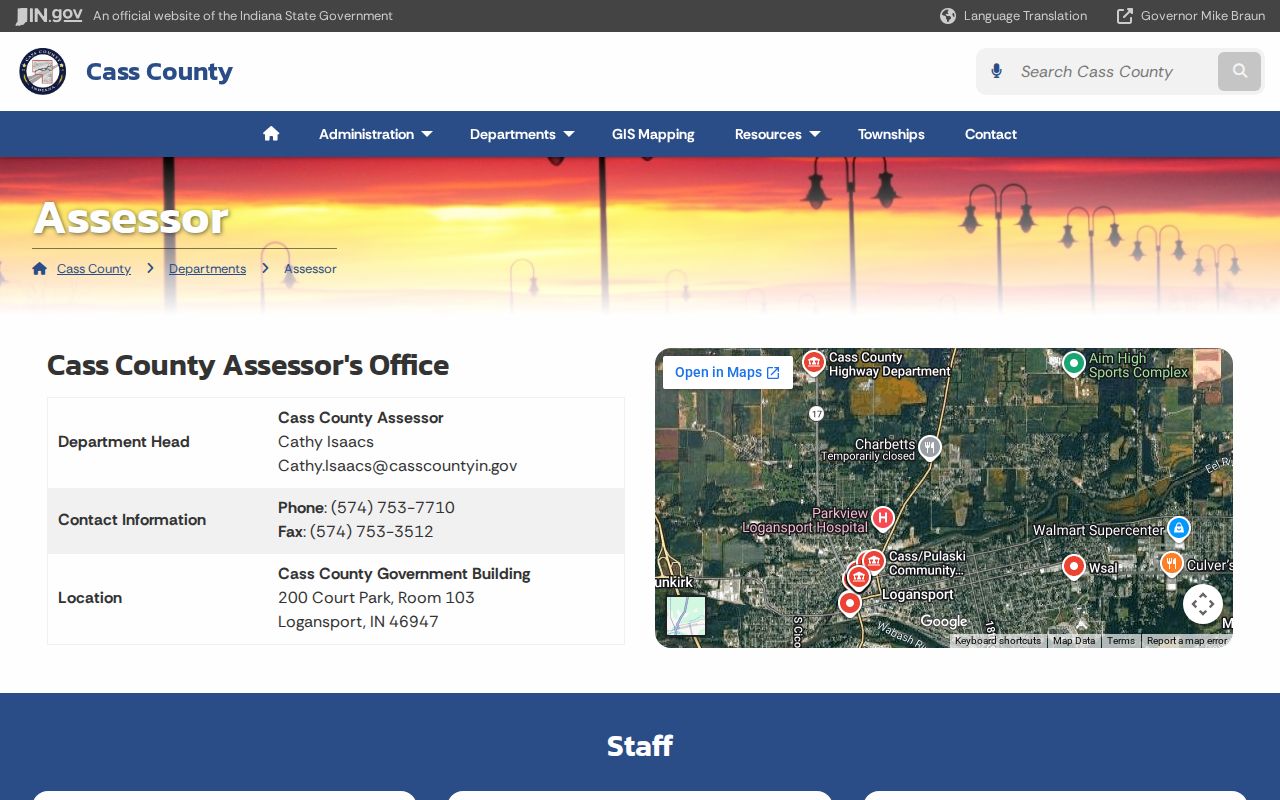
The Assessor's property records explain what sits around an owner entry. Property class and assessed figures come from that side. The county tax detail supplies the "Deeded Owner" label, the strongest name match a Cass County parcel search offers. Neither source stands in for the Recorder's deed when ownership itself needs confirmation. Always trace the deed before relying on a name alone.
One Cass County parcel shows how the cross-checks work. It carried one acre, a Jefferson Township tax district, the Pioneer Regional school district, a rural US 24 situs, and a PLSS-style legal description. If the owner of record looks right but those facts point somewhere else, pause. Find the correct parcel first, then search the deed index.
Ask the Right Cass County Office When Systems Disagree
When Cass County systems disagree, take the question to the right custodian. The Auditor, at 200 Court Park, Room 105, Logansport, keeps the permanent ownership record. That office accepts transfer documents and sales disclosures, corrects the tax duplicate, and maintains plats. Call 574-753-7720 if a deed has recorded but the online owner trail still looks stale. Have the parcel number, Tax ID, parties, recording date, instrument number, and legal description ready.
The Recorder, in Room 102, preserves the conveyance and encumbrance record from 1829 forward. Call 574-753-7810 or visit weekdays from 8:00 a.m. to 4:00 p.m. Recording stops at 3:30 p.m. Paid remote systems do not always fit. Ask for an office index search then. Ask too when the deed image predates 1982.
Some disputes need a different office entirely. Sometimes a death or judge-signed transfer sits behind the problem. The Clerk's probate or property case may then explain who holds authority. Mapped parcel questions go to the Auditor's GIS team and the Surveyor. Match the question to the custodian. That keeps a tax clerk, map viewer, or business registry from being treated as a title service.
Record an Ownership Finding You Can Recheck
Write down what you found and how. Save the search date, tax year, and the complete Deeded Owner wording. Also record the situs, mailing address, parcel number, Tax ID, and legal description. Add the latest deed date and its document reference. When two Cass County property records disagree, keep both versions with their dates. Do not quietly pick one. That short audit trail lets anyone repeat the lookup. It survives a transfer posting or a parcel change.
A certified Recorder copy proves only what the retained document contains. It does not promise that no other interest exists. For a purchase, disputed inheritance, boundary conflict, or any legal reliance, get a full title examination. It may reach beyond the owner-finding method.
Limits of a Cass County Owner Lookup
A public record can name the owner and the instrument that conveyed the interest. It cannot show who occupies a house. It cannot resolve every lien or unrecorded claim. Nor can it prove a mapped line is a surveyed boundary. Indiana confidentiality programs may also shield addresses in qualifying cases. Professional title work still has its place.
Use ownership records responsibly. An owner name from a tax roll is not a title search, and public information may not be used to stalk, threaten, or harass anyone.
Put the record trail to work for purchase due diligence, boundary questions, estate research, deed-fraud monitoring, or property history. Cass County property records answer many of those questions directly. When legal rights turn on the answer, order the recorded document or certified copy and get professional advice.